


As you may have heard Microsoft is rolling out in the US a revised version of Bing that includes a way to involve Facebook friends in the search process.
The move appears to be a response to Google’s “Search Plus Your World”, its own attempt at social integration, but it’s more than that. Bing believes it can make search better by enabling users to pose questions during the search process to Facebook users. This can be done through a new sidebar interface. It looks like this:

This is an example of a search for seattle restaurants. On the left you have the traditional paid & organic results. In the centre you have a “Snapshot area” which provides specific information like restaurant phone numbers, maps, hours of operation and reviews. On the right you have the “Social Sidebar”, where Bing pulls in its social results from not just Facebook but also Twitter, LinkedIn, and Google+, among others. Here you will be shown which of your friends are likely to be able to help with your query, together with a selection of experts who have blogged or tweeted about the topic you have searched for. Bing then enables you to start engaging with them without having to ever leave the engine.
How is this different from Google Search Plus Your World?
One major difference is that Google combines social results into their organic listing. The engine has been heavily criticised for force feeding Google+ on us, pushing Google+ results at the top of the page and ignoring more relevant results from other social networks, damaging the quality of their search results. Bing, on the other hand, leaves the social results to the side so that they complement the organic results without compromising them.
However, the biggest difference is that Bing is open to all social networks. As mentioned, the sidebar shows results from your Facebook, Twitter, LinkedIn and even your Google+ connections, so it has a level of depth Google cannot possibly match.
Benefits for Bing
Bing’s social integration is clearly an attempt at increasing market share. The company aims to do this in two ways. First of all, by becoming the default search engine on Facebook Bing will have access to the social network’s 900+ million users. As more and more people start searching on Facebook, more will start using Bing. In addition, the ability to consult through Facebook with friends and experts will enable Bing to become the perfect “Decision Engine”. Bing claims that 90% of people consult with a friend or expert before making a decision. If this were true, Bing would become the perfect place to go for people looking to buy something.
Benefits for Facebook
Having Bing’s search functionality allows Facebook to go one step further in becoming the all-encompassing internet website it aims to be.
Furthermore, the integration will help Facebook’s targeted marketing strategy. Now, rather than place tailored ads in its sidebar based on users’ personal info and “likes”, Facebook can in theory draw from their search habits to display related links and take a cut of any subsequent money spent on Bing. And who knows, if this tie up proves to be really successful then Facebook might even look at launching its own search engine.
Why is this important to Brands?
An increasing number of potential customers will now be exposed to brands’ Facebook content. Community managers for brands will have to keep this in mind because everything they publish through Facebook will have the potential to show up in search.
There’s also a great opportunity to gain customer insight. For example, trends will start to emerge around which types of content or commentary on Facebook, blogs, etc. have a higher likelihood of getting pulled into the social side bar (under ‘Friends Who Might Know’, but more important for companies under ‘People Who Know’). This can help inform the creation of content that has a good chance of being viewed in Bing’s eyes as authoritative.
Implications for agencies
Do not dismiss Bing. There is more to search than Google, and although Bing’s market share is currently low in Europe this move could be game changer. Facebook has the volume to make social search relevant and appealing through Bing in a way that will be out of reach for Google until its own social network can match Facebook’s user base.
Companies have to focus on creating great customer experiences. If you don’t have an effective strategy to engage with users in social environments, you will not be building the social signals that Bing is looking for. That means that if you launch a product that no one “Likes” you’re not going to show up in the search results.
B2B. Implications are so far limited for B2B advertising. But, as more people use Facebook for business by liking companies or industry stories, the database to power business-related Bing searches will increase. Therefore, to increase visibility in Bing it will be very important to link as many resources as possible to Facebook. The more likes you receive, the more likely you will be to show up in a Bing search.
On Tuesday afternoon I attended the Google+ Social to wish happy 1st birthday to Google+, and hear a series of talks highlighting the success they have had using the channel.
Google used this opportunity to discuss the latest figures and updates for Google+, highlighting an impressive 250 million users in one year, with 150 million active and 75 million daily users. Livia Zuppardo, Product Specialist for Google also announced the new features being added to the product such as the beautifully crafted Events section (try out Party Mode for your phone!), the creation of apps for Hangouts, a better offering for mobile and tablet devices, and a new Recommendations tab (very much a more influential +1). All of these are simple offerings to make Google+ better for the user, but apparently there are much more exciting features to be released in the next year!
Anyway, I am very open to using Google + as a platform for our clients as I can see the enormous search benefits that are available, but also that you can get a much more engaged audience with the right brand through the early adopters of the platform and therefore providing much more exclusive content to these fans and seeing a greater return than other social channels. This was highlighted from the speakers that presented to us, Jerry Daykin from Cadbury, Richard Kemp from Late Rooms and music sensation Daria Musk.
Each speaker discussed the huge success they have received globally through the use of Google+. With each brand boasting huge numbers of fans for a platform that is just over a year old and each seeing search advantages to the product and an increase in sales, you can see that these are the success stories, but I wonder whether this is attainable to social departments who don’t have full backing from their company or client. For example, Cadbury’s have been incredibly successful on Google+ but they also have had financial backing to create great content to post, along with providing hang outs with Olympian Rebecca Adlington. This gives huge incentive for people to follow them, and therefore a greater chance to increase sales.
If you don’t have this sort of backing, is it possible to attract a large audience on such a new platform? Only time will tell. For now though, I’m going to continue thinking up strategies for Google+ and push the channel as an important method of reaching your fans, along with chilling out with the G+ sunglasses and flip-flops I was given!
@BenSheppard89
What a couple of days we’ve had.
Colleagues from all areas of our business - paid search, natural search, social media, mobile and conversion all descended onto the Online Marketing Show over Wednesday and Thursday to showcase what we do and how we do it!

We took over the Online Networking and Data Bar which was smack in the middle of the Online Marketing Show and the Data Show – although we wouldn’t exactly encourage the consumption of alcohol first thing in the morning, it was available if anyone wanted it. And I’m delighted to say that no-one did before 12 noon (or if they did, they hid it VERY well).
The highlight of the two days was our very own Commercial Director, Neil McCarthy, presenting on search and social marketing as an integrated digital strategy. He played to an almost packed arena early on Thursday afternoon and covered what you should be doing, why you should be doing it, and how you should begin. In particular, Neil covered a variety of social channels i.e. how they work as a silo but how they work better if integrated with search. For example, Google says they don’t count tweets in rankings but a popular tweet containing a link earns a lot of re-publishing across the web which Google does crawl, index and count. Likewise, instead of simply updating a post, why not use Facebook to drive back to the site using a link?
Neil’s takeaways from the session were:
- The world is changing and the rate of change is becoming faster
- Your customers don’t act in silos
- Think like a publisher - profile your customers and act accordingly
- Shareability and distribution is key
- Use Google+ more than you think you should
- Multi-purpose everything
- Mobile, mobile, mobile
For those of who visited us – great to have met you, and those who we didn’t – come and see us in Covent Garden soon!
Any instance in which Google decides to lift the curtain a little on how its auctions are run, is cause for celebration in the paid search community as it limits the amount of guesswork we all need to do for our clients. Therefore, emotions were running high when Google released their new Auction Insight Report last month - for the first time shedding some light on competitive keyword performance.
The idea itself is incredibly helpful as the new report is designed to give you insights on statistics such as:
Impression share – allowing you to see who else is bidding on the same keywords as you and how much visibility they are receiving.
Average position – how you and your competitors rank for a particular keyword.
Overlap rate – how often your competitors received an impression in the same auction as you.
Position above rate – how often a competitors ad appeared above yours In auctions where both you and they received an impression.
Top of page rate – how many times your competitors ranked at the top of the page out of all impressions received by them.
 The tool is a useful way to help you keep closer tabs on your competition and to obtain more detailed keyword data in comparison to the simple impression share tab previously available. It can be helpful in making decisions related to individual bids, budgets and keyword choices.
Unfortunately, it is currently only available for individual keywords, which means that any keyword competition reports need to be compiled one-by-one if more keywords are to be compared. Another downside of the Auction Insight Report is that it is only available for keywords which ‘have had enough activity for Google to generate a report’. Now with Google being Google, it doesn’t disclose how much activity that is. Since its release Google removed the icon indicating whether a report is available for a particular keyword, which means the only method of finding the comparison data for individual keywords is trial and error.
In spite of these minor flaws, the Auction Insight Report provides much needed information which can only lead to more educated decisions undertaken in campaign management.

Social sharing is now a well-established part of our daily lives and as such, we are communicating via platforms such as Twitter and Facebook on a regular basis.
There are subtle differences between each of these but they are both leaders within the social space, it is generally presumed that if someone is using social media, they must be using either Facebook or Twitter and for some, both.
As someone who uses both, I can honestly say I use both platforms for totally different reasons. And as someone who works in marketing, I see Twitter as a hub of information and follow everyone and anyone with the same interests as me.
When a news story breaks or I overhear a piece of information that I want to confirm, it isn’t a news website like BBC that I check – it’s Twitter.
In the last year, there have been many times when Twitter has broken news stories which otherwise we might not have heard about or wouldn’t have quite so quickly, if it hadn’t been for someone’s personal tweet.
For example, Whitney Houston’s death was first announced on Twitter by the niece of the maid that found her body, news of Barrack Obama’s trip to Afghanistan was leaked on Twitter and when Michael Jackson died, it was Facebook that informed me of the news.
There has been many an argument over the legal implications of Twitter and the updates people are entitled to make via the social network. For example, a story about a certain footballer’s indiscretions and the riots in London last summer. Twitter now puts a blanket on certain information so that large groups of people aren’t able use the network to promote illegal behaviour.
So why do I use Twitter and why do I use Facebook?
Well that is an easy question to answer, I use Twitter to:
- Promote my blog
- Communicate to like-minded people
- Communicate with celebrities and authority figures
- Find out information
- Socially view (explanation below)
- Communicate with brands
- Update me on the news
I use Facebook to:
- Keep in touch with friends and family
- Communicate with brands
- Look for offers
- Look for inspiration
- ‘Banter’
When I think about the circumstances in which I use Twitter the most, it tends to be in the evenings while I am watching TV – also known now as social viewing. As an example, during last night’s football match, I tweeted three times and updated my status once. I then proceeded to have notifications of likes, retweets, conversations with celebs and peers on Twitter and general banter with friends via their Facebook status.
Social viewing is one of the latest marketing objectives to influence the social sphere. Many brands are now building it into their social strategies to compliment and add greater value and impact to their above-the-line advertising campaigns, which have been suffering due to on demand technology.
So, how is this new form of marketing being affected by Euro 2012?
We have already seen #England2012 trending as a promoted tweet on Twitter during England’s first match. This has encouraged fans to comment using the hash tag, create an on-going conversation and lead a percentage of those using the hash tag to the brand using the promoted tweet.
When it comes to football in particular, every man and women feels that they have a greater knowledge than the England Manager at the time. Twitter allows them to have a voice on this and feel that they are being listening to.
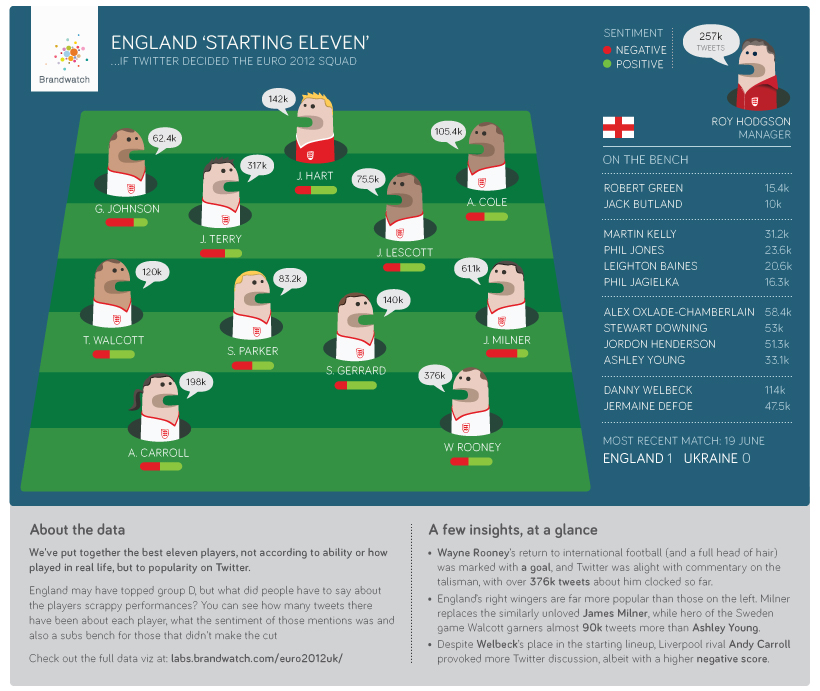
Brandwatch have created this infographic based on what people were saying via Twitter during last night’s England football game.
There has been speculation for some time that Microsoft would be entering the tablet market as a direct competitor to Apple’s iPad and Google’s Android devices. This market has exploded over the past 2 years, with Apple’s CEO, Tim Cook, stating in March that the tablet will soon surpass the market for PC’s.
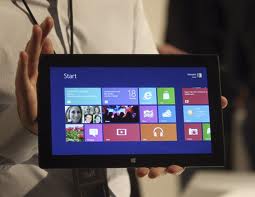 With this week’s announcement of the launch of the Surface tablet, what does Microsoft’s entry into this market really mean for competitors and consumers?
For starters, Windows 8 (due out in October) is specifically designed and built for use on tablets and touchscreen devices which is going to make it a hard act to follow for other competitors.
Prior to the development of Surface, Microsoft collected licenses from their software being used by other hardware producers so where does this leave these other producers now? Sure, they may have agreements in place to continue running Windows software but will consumers really want to purchase these now that Microsoft themselves are in the running with a complete package?
Microsoft is aiming its sights at both the consumer and enterprise market, with one Surface model running Windows RT (ARM – with either 32GB or 64GB) and the other Surface running Windows 8 Pro (Intel – either 64GB or 128GB). This version is heavier but will have a higher resolution – and therefore could appeal to the corporate market.
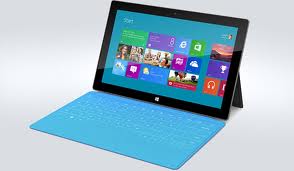 Design-wise, a selection of magnetised, protective covers will enable consumers to personalise the tablet which also doubles up as a keyboard. The addition of this innovative keyboard may well persuade potential PC purchasers to change their minds and choose a more ‘flexible’ and portable device instead. The slimline keyboard can more than replace a laptop as it will enable users to view the see it as a central tool rather than using several devices for similar purposes. The current version of the iPad simply cannot replace a laptop.
So this seems to be a great new development in the market for the consumer but not so much for others. Especially those hardware partners who run Windows on their devices already, as Microsoft have well and truly thrown down the gauntlet. Who will respond first? We eagerly await the response from the market when Surface becomes available for purchase.
This morning it was reported that Microsoft may be about to purchase business social network, Yammer - but the question on the tip of everyone’s lips at the moment, is why?
Over the last few months we have seen many a significant consolidation in the social business space, with Salesforce buying both Radian6 and Buddy Media and Oracle purchasing Vitrue. Therefore, it makes sense that Microsoft, who hasn’t produced a successful tool themselves to date is acquiring one of the leading enterprises in social software. So an acquisition like this by Microsoft wouldn’t be the first of its kind.
As a social network, Yammer isn’t competing with the personal social networks such as Facebook. It’s a tool to help businesses operate more efficiently internally and Microsoft has always played in this space, so this seems like a good, natural fit and could be integrated into Microsoft’s suite of products.
Yammer has a business model, all be it a freemium one (it’s free but has a premium version) and has good traction among big brands – 80% of the Fortune500 use it. That said, I haven’t seen any revenue or profit details from Yammer but I would guess that Microsoft can see a positive revenue line to justify a $1bn+ valuation.
As mentioned above, this space is ramping up, fast and the implications of the deal affecting the social business area are already being speculated upon. This is due to the fact, that more businesses are beginning to understand the different facets needed to become a ‘social business’. Having a highly connected and collaborative workforce is central to this.
The high valuation shows that Microsoft are serious about the space. Whether or not this $1bn deal will legitimise the social business sector will remain to be seen. We are still in the early stages of brands adopting the mindset of being truly social and once that develops, the need for the tools will follow shortly after. I would expect to see the social software space continue to grow over the next year.
So Facebook went public on Friday 18th May 2012 and there have been plenty of suggestions as to why Zuckerburg let the company go public. Does Facebook want to build products, did Zuckerburg sell up as he doesn’t feel that he can take Facebook any further or is the competition ramping up to be something to be scared of? Only Zuckerburg really knows.

Ultimately Facebook needs to make money for its investors, so selling up and going public makes sense. However, the suggestion of the creation of products is something that is quite intriguing.
Over the past few weeks Facebook have announced that they are working closely with Apple, along with hiring former Apple iPhone developers. Does this mean that Facebook are planning to build their own phone or will Facebook now have deeper integration in Apple products? Either way it seems that Facebook are finally aiming to have a good crack at mobile devices as they are yet to provide a good offering on mobile. Google + on the iPhone is a beautiful integration, so will Facebook start to monetise their ads with mobile? Remember that Google have recently announced with integration of AdMob into AdWords.
The punt at mobile would make sense with Facebook buying Instagram and also releasing the Facebook Camera. It will be interesting to see how Facebook plan to monetise their mobile-based platform.


Another suggestion could be a plan to have deep integration with Apple TV. Apple CEO, Tim Cook said ‘stay tuned’ at the end of May for the latest announcement regarding Facebook and Apple, could he be hinting that TV may well be on the agenda? Social TV has been a bit of a buzz phrase over the last twelve months and could be something that really kicks off and provides enjoyment to its users.
Personally, I think it is a plan to offer deeper integration of Facebook in Apple products in order to increase the ad revenue and to improve the targeting, with Facebook playing around with their open graph and ticker feed helping with the targeted ads. This is where Facebook are now taking information from what you are currently doing online as well as on Facebook - not just targeting you with ads from your list of ‘Likes’.
Melbourne. Sepang. Shanghai. Sakhir. Montmelo. Monte Carlo. Montreal. 7 different cities, 7 different winners. What else could I be writing about other than the Formula 1 World Championship? Yesterday evening’s Canadian Grand Prix was one of the most thrilling races of the season so far.
I began writing this blog post before we’d reached the halfway mark of the race as it was so exciting – specifically on Lap 21 of 70 just after the three world champions of Alonso, Hamilton and Vettel overtook each other, made pitstops and changed tyres.
 For those who are about to stop reading, as it so often claimed that F1 consists of cars driving around a circuit, in this race in particular you couldn’t be more wrong! Although I confess that not each race is as all-consuming as this one was.
All three drove into the pits within the space of 4 laps. Each pitstop at this particular circuit lasts approx. 14-15 secs from entering the pit lane to the exit which includes the 3-5 seconds it takes to change all four tyres. Under normal circumstances this would generally mean that the leaders should emerge one after the other all being well, also assuming that each driver makes the same amount of pit stops at around the same time. But when you have different pit strategies and different tyres, the leaders change at a rapid rate - especially considering that it takes at least a quarter of a lap for the new tyres to warm up to race temperature. All of this ensured that Hamilton, Vettel and Alonso switched track positions over the space of a few laps.
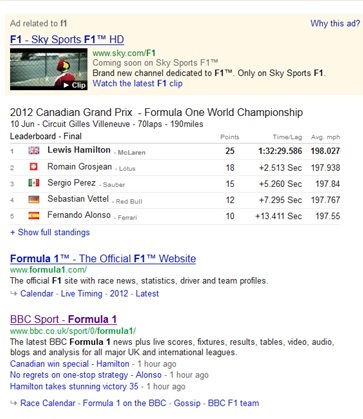
What drove me to at least begin this blog yesterday was the sheer volume of choices I had in which to watch the race. I won’t get into the whole BBC v’s Sky Sports F1 argument (actually, the full live race was only broadcast on SSF1 as part of the agreement). I’d been out during the day yesterday and stupidly forgot to check on the start time of the race, as I wasn’t sure if the time difference between Montreal and the UK was 5 or 7 hours. So I Googled it on my iPhone, the top paid search listing of which was the Sky Sports F1 channel. Easily clicked on the link which took me through to the website. Alternatively, I could have watched it on my phone but I thought I’d just about make it home in time.
But I didn’t. So when I began watching the race itself on Sky+ (I only purchased the Sports channels on Sky for the F1 channel) I had the option of pressing the red button which gave me the option of being closer to the action i.e. using ‘Race Control’ which is a ’multi-video option to put the viewer into the driving seat with on-board cameras, pit lane footage and in-race highlights’. To an F1 geek like myself, this sounded like manna from heaven! Unfortunately as I was watching it on Sky+, I wasn’t able to use the red button feature, so rather disappointing.
During the race I was tempted to read the live Twitter feed on various sports websites or on Twitter itself but I managed to resist. Video was being uploaded featuring driver interviews during the race but I was nervous about watching that simultaneously with the race as there was a time delay and I may find out something that was yet to happen thanks to my delayed start. I also had to turn off my Facebook alerts as I just knew that conversations would be taking place over the latest leader, who’d just set the fastest sector time of the race or why Hamilton anti-stalled towards the end of his pit stop.
All in all, I was rather impressed with the number of digital options available to me (a couple of which I didn’t know existed) - and all because I forgot to check what time the race began!

